CPWO Research Seminar
Understanding and Addressing Online Harms Against Women and Girls through Research
Online spaces play a huge role in our everyday lives, offering connection, creativity, and community. Yet for many women and girls, these spaces can also bring real risks and harm. These Research Seminars open up a shared conversation about how research can help us understand these experiences and find practical ways to make digital spaces safer and more inclusive. Bringing together researchers, students, practitioners, and members of the wider community, the event is an opportunity to learn from one another, share insights, and explore how we can work collectively to create lasting change.
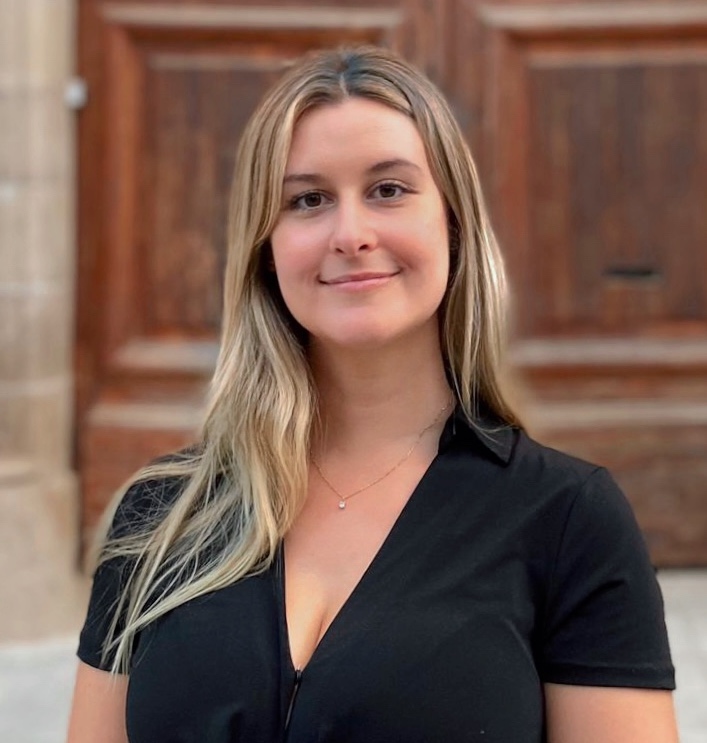
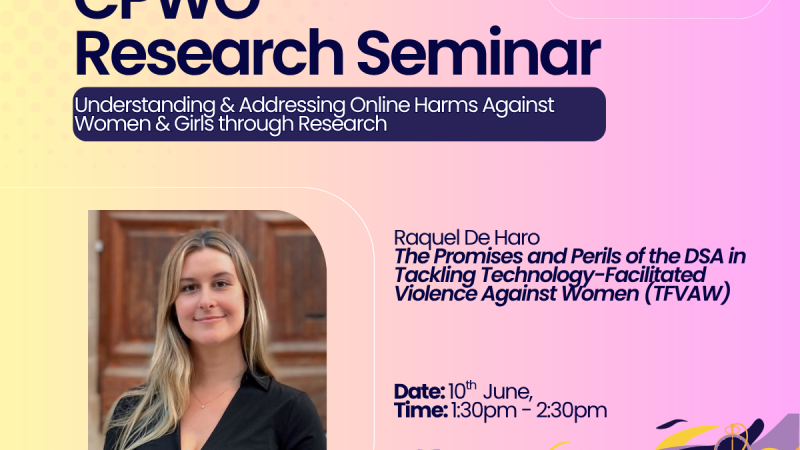
We are delighted to welcome Raquel De Haro to lead this Research Seminar. Further details about the talk, the speaker’s biography, and a link to book a place are provided below.
The Promises and Perils of the DSA in Tackling Technology-Facilitated Violence Against Women (TFVAW)
Public debate around digital regulation is often framed through false dichotomies, like regulation versus innovation, or free speech versus content moderation, as if one necessarily implied the absence of the other. This framing overlooks a more pressing question: whether the existing legal framework is actually equipped to address the systemic harms that women and minorities face online. Building on cases like the Grok scandal, where non-consensual deepfakes circulated globally on X, including representations of minors, this intervention reflects on the promises and perils of the EU Digital Services Act (DSA) and its interaction with other regulations like the AI Act in tackling Technology-Facilitated Violence Against Women (TFVAW). The EU response remains fragmented, reactive, and ad hoc, ill-prepared for the forms of abuse that are yet to exist. The recent Digital Omnibus, which introduces a ban on AI-nudifying apps, is an illustrative example: a late answer to harms that civil society and academia have been flagging for over a decade. Moreover, the over-reliance on transparency as the main tool of platform accountability risks turning compliance into a performative exercise and makes enforcement harder to achieve. As a consequence, women and minorities are systematically pushed out of online spaces, silencing their voices and producing a chilling effect on freedom of expression. The alternative, however, is not the absence of intermediary regulation, but a legislative process that meaningfully integrates feminist approaches and acknowledges that innovation and free speech are not incompatible with an equal participation of all citizens online.
About the Speaker
Raquel De Haro is a PhD candidate at the Center for Law & Economics at ETH Zurich (Switzerland), an International Visiting Fellow at the Centre for Protecting Women Online at The Open University (UK) and a Visiting Scholar at Columbia Law School (USA). Raquel’s research focuses on digital regulation, particularly platform governance, online safety, and privacy, with a focus on Technology-Facilitated Violence Against Women (TFVAW). Her work employs empirical methods to study the EU’s General Data Protection Regulation (GDPR) and the Digital Services Act (DSA). Before joining ETH, Raquel interned at the European Commission, the Catalan Competition Authority, and Cuatrecasas. She is admitted to the Spanish Bar.