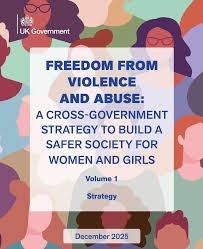
When the Government published Freedom from Violence and Abuse: A cross-government strategy, the Centre for Protecting Women Online issued an initial response welcoming the recognition that online abuse and technology facilitated violence form part of women’s lived experiences. That early statement reflected our first reading of the Strategy and its accompanying Action Plan.
Since then, the CPWO has undertaken a deeper analysis, drawing on cross disciplinary expertise across law and policy, policing, human behaviour, responsible technologies, and the future of AI. This work is grounded in our focus on technology facilitated violence against women and girls (TFVAWG), and on how digital systems shape, sustain and amplify harm.
The reflections set out below represent a more detailed consideration of the Strategy as it moves from publication into implementation. We have shared these reflections with Ministers in the Home Office and the Ministry of Justice, with the aim of supporting constructive engagement and strengthening delivery of the Strategy.
Positive foundations
The Strategy represents a clear improvement on previous iterations in both scope and coherence. The cross-government framing across education, health, policing, digital regulation and local government is a significant development. The explicit emphasis on primary prevention, rather than an exclusive focus on responses post-harm, strengthens the overall strategic direction.
The continued prioritisation of victim and survivor support provides an important foundation for delivery. Commitments to investment, recognition of barriers within the legal system, and explicit reference to specialist by and for advocacy services reflect a more realistic understanding of the challenges many victims face when seeking help. The acknowledgement of systemic barriers within criminal justice processes is particularly important in setting the conditions for improved victim experiences.
The Strategy’s focus on prevention through education is also a clear strength. Emphasis on relationships and sex education and wider school-based interventions recognises the role of early and sustained education in challenging harmful norms, supporting healthy relationships, and reducing the normalisation of sexism that can lead to abuse. Given the influence of online environments on attitudes and behaviours, this provides a credible basis for longer term cultural change.
Technology facilitated violence must be embedded, not auxiliary
TFVAWG does not occur in isolation, it is embedded across online and offline experiences and is integral to many forms of abuse. While the Strategy references technology facilitated harm, it is often treated as an additional issue rather than as a core dimension of how violence against women and girls is experienced.
This framing risks underplaying the role digital technologies play in shaping and sustaining abuse. Harm frequently moves between online and offline contexts, with digital tools used for coercion, surveillance, harassment and control. Treating technology facilitated abuse as peripheral limits the Strategy’s ability to reflect lived realities and develop effective responses.
The Strategy also focuses on a relatively narrow set of technology facilitated harms, including non-consensual intimate images, cyberflashing and violent pornography. Other prevalent and harmful behaviours such as cyberstalking, doxing, sextortion, impersonation and multi-platform harassment remain insufficiently addressed. These behaviours are often interconnected, cumulative and persistent. Without clearer recognition, victims may not see their experiences reflected, and opportunities for coordinated and preventative responses will be missed.
Prevention beyond childhood and formal education
The strong emphasis on children and young people within prevention and early intervention is understandable and important. Education based approaches, particularly through relationships and sex education, are a necessary component of long-term prevention. It would be even stronger if the approach did not treat children as a homogenous group, instead better reflecting and seeking to understand the online harms experienced by girls.
However, the Strategy is less clear on how it addresses escalation and harm among young people and adults who are no longer in formal education. Many adults remain exposed to harmful narratives and behaviours, particularly within online spaces. This raises questions about how young women’s and adult women’s experiences of technology facilitated abuse are accounted for within prevention frameworks.
The Strategy also does not sufficiently engage with how masculinities are produced and reinforced through systems and different social contexts, and how they may be challenged over time. Not all men who encounter harmful content go on to perpetrate abuse, but many lack opportunities to understand how gendered systems operate, how women experience harm, and how everyday behaviours can reinforce inequality. The online radicalisation of some adult men through misogynistic communities and content ecosystems represents a significant gap in current prevention approaches. Supporting men and boys to develop critical awareness and to understand allyship is an essential component of meaningful prevention efforts.
Implementation, accountability and regulation
Across several commitments, the Strategy lacks clarity on how delivery will occur in practice. References to working with industry, deploying new technologies, or making the UK one of the hardest places to access harmful content would benefit from greater specificity. Questions remain about who government will work with, what concrete actions will be taken, and how effectiveness will be measured.
There is also a risk that industry defined concepts of safety do not align with the needs and experiences of victims or frontline services. Poorly designed interventions can displace harm into less visible online spaces rather than reduce it. Clear accountability and evaluation mechanisms are therefore essential.
In this context, the role of Ofcom as regulator under the Online Safety Act is highly relevant. Greater clarity is needed on how regulatory powers will be used to address TFVAWG, and how the Strategy aligns with Ofcom’s enforcement priorities and capabilities.
Platform responsibility and technology governance
The Strategy places primary emphasis on individual perpetrators and victims, with limited attention to the role of platform design, algorithms and moderation systems in enabling or amplifying harm. Structural factors such as algorithmic amplification of misogyny and discrimination, engagement driven incentives, data permanence, anonymity and scale are not addressed in a meaningful way, despite their central role in technology facilitated abuse.
While the Online Safety Act may address some of these issues, it does not provide a complete response to TFVAWG, particularly given the rapidly evolving nature of online harms. Reliance on voluntary safety by design approaches raises questions about incentives, risk assessment and accountability across the full lifecycle of technologies, including misuse after deployment.
Victim survivor support and reporting
Although the Strategy includes a strong support pillar overall, it does not sufficiently address the specific needs of victims and survivors of tech-facilitated abuse, which as stated previously cuts across most forms of VAWG. This includes support to manage digital identities, respond to persistent online harm, access effective content removal processes, and understand platform responsibilities around data preservation for investigations.
The Strategy does not meaningfully engage with under reporting of technology facilitated abuse or with the reasons many victims choose not to report. There is limited consideration of how reporting could be made safer, more transparent, or more meaningful for victims, nor of how outcomes are communicated. The absence of discussion on reparation for harm experienced is also notable.
Across the document, victims and survivors are primarily positioned as service users rather than as contributors of knowledge. Lived experience, particularly from marginalised women, represents an important form of evidence that is not consistently reflected. Neither are the experiences of LGBTQ+ women, with the Strategy seemingly focusing more on heteronormative relational dynamics.
Intersectionality and compounded harms
While intersectionality is acknowledged, it is not applied consistently throughout the Strategy. References to ethnicity are limited and often appear in sections focused on perpetrators rather than on victim experiences.
There is insufficient engagement with how technology facilitated abuse disproportionately affects women facing multiple and compounded barriers, including migrant women, racialised women, disabled women and LGBTQ+ women. Without explicit attention to these dynamics, there is a risk that implementation will reflect mainstream experiences and reinforce and compound existing exclusions. This risks undermining the effectiveness of any plans rolled out from the Strategy.
We are also concerned about a total firewall not being put into place for migrant women’s immigration status being shared with relevant authorities when reporting experiences of abuse to the police, as well as a lack of commitment for ring-fenced funding for by and for support services.
Criminal justice, capacity and safeguards
The Strategy’s emphasis on the relentless pursuit of perpetrators raises important questions. Existing offences, such as cyberflashing, remain narrowly defined and do not capture the many harmful behaviours, which we are still understanding. Acknowledging gaps in the law without addressing how they will be remedied leaves uncertainty about responses to harm that falls outside current thresholds or is not covered in legislation at all.
There is also a need for clearer safeguards around proposed measures such as expanded surveillance or undercover online activity. Without careful design, these approaches risk unintended consequences for privacy, whistleblowers and victims themselves, and pose particular risks for racialised women.
More broadly, reliance on criminal justice responses does not reflect the realities of technology facilitated abuse, which is often cumulative, difficult to evidence, and may not meet criminal thresholds. Long standing gaps in police digital capability and training further challenge delivery, and contrast with the Strategy’s victim centred language. Furthermore, the reform of the law itself does not carry with it the reform necessary of the criminal justice systems, its agents and institutions. It also does not respond to structural issues embedded into either.
Looking ahead
These further reflections are offered to support constructive engagement with the Strategy as it moves into delivery. As a Centre bringing together cross disciplinary expertise on TFVAWG, CPWO welcomes continued dialogue with government, regulators and partners to ensure that implementation reflects how abuse is experienced in practice, both online and offline.