CPWO Research Seminar – July
Understanding and Addressing Online Harms Against Women and Girls through Research
Online spaces play a huge role in our everyday lives, offering connection, creativity, and community. Yet for many women and girls, these spaces can also bring real risks and harm. These Research Seminars open up a shared conversation about how research can help us understand these experiences and find practical ways to make digital spaces safer and more inclusive. Bringing together researchers, students, practitioners, and members of the wider community, the event is an opportunity to learn from one another, share insights, and explore how we can work collectively to create lasting change.
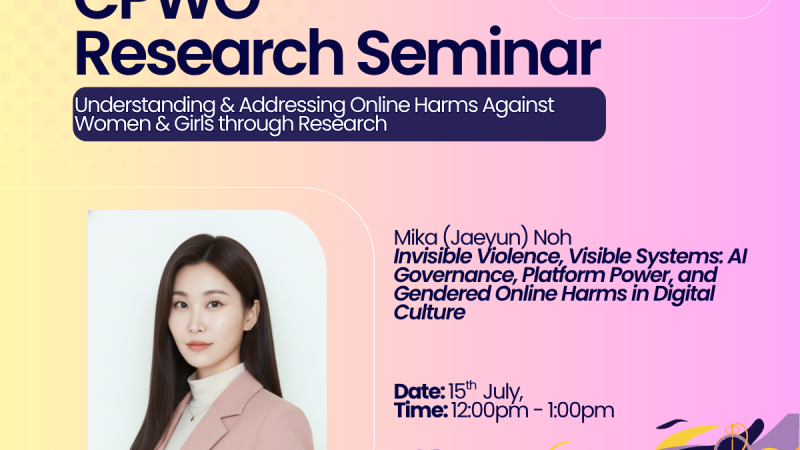
We are delighted to welcome Mika (Jaeyun) Noh to lead this Research Seminar. Further details about the talk, the speaker’s biography, and a link to book a place are provided below.
Invisible Violence, Visible Systems: AI Governance, Platform Power, and Gendered Online Harms in Digital Culture
As generative AI, recommendation algorithms, and platform governance systems become embedded in everyday digital life, online harms against women and marginalized communities are increasingly shaped not only by individual actors, but by invisible technological infrastructures. Harassment, image-based abuse, algorithmic suppression, synthetic media manipulation, coordinated targeting, and reputational attacks are no longer isolated incidents; they are amplified through systems designed to optimize visibility, engagement, and data extraction.
This seminar examines online harms through the lens of AI governance and cultural infrastructure, arguing that digital violence must be understood not only as a legal or platform-moderation issue, but as a broader governance problem involving institutions, algorithms, and power asymmetries within digital culture.
Drawing from developments in East Asia and global AI governance debates, the presentation explores how algorithmic systems shape visibility, legitimacy, and participation online, particularly affecting women, artists, researchers, and marginalized voices operating across digital public spaces. The seminar will address emerging challenges including generative AI-enabled abuse, deepfakes, automated reputational harms, platform opacity, and the growing gap between technological deployment and institutional accountability.
The session also considers the limitations of current governance approaches that focus primarily on content removal or compliance frameworks without addressing the underlying infrastructures that enable harm circulation. In response, the seminar proposes a more interdisciplinary framework connecting AI governance, digital rights, cultural policy, and survivor-centered institutional accountability.
Combining policy analysis, platform governance research, and perspectives from cultural institutions and creative industries, the seminar aims to foster discussion on how researchers, universities, policymakers, and civil society can collaboratively build safer and more equitable digital environments.
The session is designed for researchers, students, practitioners, and interdisciplinary audiences interested in online safety, AI governance, gendered digital harms, and the future of democratic digital culture.
About the Speaker
Mika (Jaeyun) Noh is a cultural strategist and researcher specializing in AI governance across art, policy, and the creative economy. Her work focuses on how generative AI is transforming authorship, cultural institutions, and global policy frameworks.
She has published across academic, policy, and international platforms including ENCATC Magazine, GovInsider Asia, Alliance Magazine, and UNESCO MONDIACULT. Her research develops frameworks for cultural data governance, including Cultural Data Trusts, and explores how AI can be integrated into human-centered and institutionally accountable systems.
Mika has been invited as a speaker at international conferences and policy forums across Europe, Asia, and beyond, and was selected as a Global Policy Fellow at the Institute for Technology & Society (ITS Rio), focusing on digital constitutionalism and cultural data governance.
She currently leads AI-driven cultural initiatives through AI Culture Lab, working with public institutions and global partners to design governance models that align technological innovation with cultural and societal values.